

John Ndirangu Wanjau was a 60-year-old smallholder farmer and family patriarch residing in the Wiyumiririe area of Central Laikipia, where he lived a quiet, modest lifestyle as a small-scale farmer. His daily routine and overall livelihood were closely tied to the local agricultural economy and family-centered obligations.
John Ndirangu Wanjau was married to Margaret Mumbi. Together, they raised three children: his daughter, Mary Muthoni Ndirangu (28), and his two sons, Charles Kihia Ndirangu (32) and Isaac Gichuki Ndirangu (24).
According to police investigations and local reports, Ndirangu and his three adult children would occasionally have disputes, which boiled down to bitter disagreements over the patriarch’s land subdivision, property ownership, and early inheritance rights. The adult children, Charles, Mary, and Isaac, wanted their father to immediately subdivide his land and formally transfer individual ownership titles to them. The siblings wanted control of their respective portions to either farm independently or use as financial leverage.
As the patriarch and legal custodian of the homestead, Ndirangu strongly resisted his children’s aggressive demands. He maintained that as long as he was alive, the estate remained under his sole discretion and management. Ndirangu repeatedly refused to be pressured into splitting up his land ahead of his own timeline, creating a severe generational gridlock that fueled intense resentment within the household.
On Saturday, April 28, 2018, Margaret Mumbi, Ndirangu’s wife, left the homestead to attend a relative’s funeral. Recognizing that their mother had gone, and that their father was isolated and without her support, the siblings seized the opportunity to forcefully confront their father, a confrontation that turned into a violent altercation.
The siblings attacked the father with sharp weapons, hacking and beheading him during the violent confrontation over their land inheritance. To conceal the crime before their mother returned, Charles Kihia, Isaac Gichuki, and Mary Muthoni dug a shallow grave just five metres away from the main family house and buried Mzee Ndirangu’s body at night.
After the funeral, their mother, Margaret Mumbi, did not return home, spending Saturday away. Neighbours who had heard the violent commotion and screams on Saturday night grew suspicious when Ndirangu was nowhere to be seen the following morning. They immediately raised the alarm and filed a report at Wiyumiririe Police Station in Laikipia County.
Following the report made to the local station, police officers and detectives visited the homestead. The initial missing person investigation quickly escalated when police discovered fresh blood spots on the ground, which they tracked directly to the freshly disturbed soil of the secret grave.
An immediate search of the homestead by investigators led to the discovery of the blood-stained weapons used in the assault. Police immediately arrested all three siblings at the scene (Charles Kahia, Isaac Gichuki, and Mary Muthoni) on suspicion of murder.
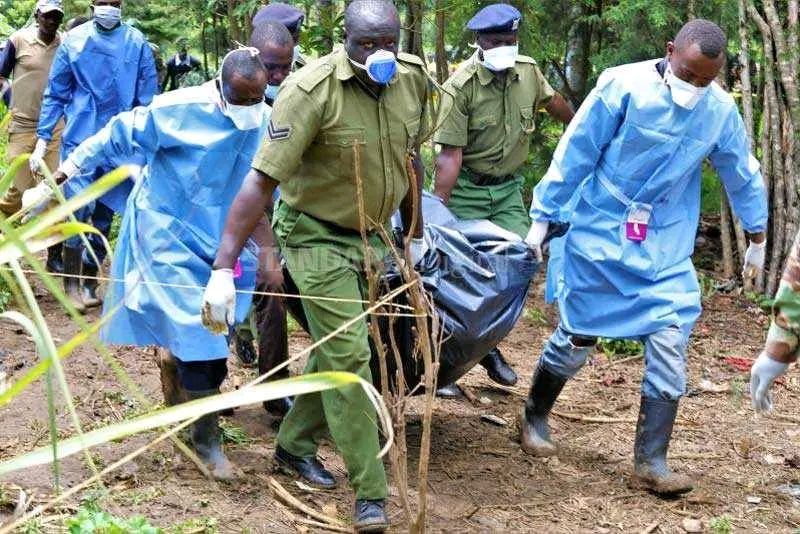
Once the courts opened on Monday morning, homicide detectives formally filed an urgent application to secure the legal exhumation order. On Wednesday, May 2, 2018, armed with the legally approved court order, a team of forensic investigators, public health officers, and police returned to the homestead to formally dig up John Ndirangu Wanjau’s body and transport it to the mortuary for autopsy.
When detectives exhumed the body from the shallow grave, the severe trauma and decapitation provided undeniable proof of a brutal, premeditated assault rather than an accidental death. The examination confirmed the patriarch suffered fatal head injuries, deep sharp-force wounds, and severe structural trauma.
This matched the physical evidence of the blood-stained agricultural tools (pangas) that investigators recovered from the scene. Pathologists officially documented the decapitation as the primary cause of death, solidifying the state’s forensic evidence for the criminal trial.
Following the exhumation of the body and forensic confirmation of death by beheading, the state officially filed formal murder charges against the brothers, Charles Kihia Ndirangu and Isaac Gichuki Ndirangu, alongside their sister, Mary Muthoni Ndirangu. The court noted that the key prosecution witnesses were the suspects’ own surviving relatives, minors, and uncles living in the exact same compound in Metha Village.
The judge ruled that forcing the minors, and the grieving widow (their mother, Margaret Mumbi) and extended family to live with the accused while awaiting trial created an incredibly dangerous and “awkward” dynamic. The siblings were held in maximum-security remand prison after being denied bond due to a “great likelihood of the accused interfering with witnesses,” including their own surviving minor siblings and their widowed mother.
The prosecution introduced major aggravating factors to the court, including premeditation, extreme savagery (decapitation), and patricide (the killing of one’s own parent). For gruesome domestic land-related homicides involving weapons and the subsequent concealment, burial of a body, Kenyan High Court judges routinely hand down long-term custodial sentences ranging from 30 years to life imprisonment to serve as a public deterrent and to ensure the protection of the surviving family members.
For the gruesome murder of their father, Mzee John Ndirangu Wanjau, the three children face long-term sentences ranging from 30 years to life imprisonment as their trial reaches its definitive legal conclusion.