
It was 1977 when Lee Njiru was transferred from the provincial information office in Kakamega to State House, assigned to serve under John M’Mwereria, President Jomo Kenyatta’s press officer. Almost immediately, the quiet mechanics of power caught his attention. Within the government establishment, powerful forces particularly key figures within the GEMA community were determined to ensure that Vice President Daniel arap Moi would never ascend to the presidency. Some were from the Kiambu elite, but others, like Paul Ngei and Jackson Angaine, hailed from elsewhere, united in their resolve to block the man from Baringo.
Moi was well aware of his standing. Knowing that Njiru was not part of the inner circle plotting against him, he called the young press officer for a private conversation in 1977. He had a simple, tactical request.
“Whenever Kenyatta travels to the Rift Valley for his working tours,” Moi instructed him, “just add a note at the bottom of the official itinerary: ‘At the same time, the Vice President and Minister for Home Affairs, Daniel arap Moi, has asked the people of Rift Valley to receive Mzee Jomo Kenyatta and give him a thunderous welcome as soon as he steps on the soil of the Rift Valley at Mai Mahiu.”
Njiru agreed. He did not support the idea of blocking a Vice President purely on tribal grounds, nor did he feel that ordinary citizens were benefiting from the political maneuvers of the ruling elite. He began briefing Moi regularly on developments within State House.
During this period, the relationship between Kenyatta and Moi was outwardly cordial. Kenyatta would occasionally assist Moi with funds for his political rallies, handing over sums around ten thousand shillings ,a significant amount at the time, though modest for a President. Moi remained extraordinarily loyal, quiet, and unassuming.
Behind the political tension lay a powerful constitutional safeguard. Attorney General Charles Njonjo had made it clear: it was treasonous to plot, plan, or even imagine the death of the President.
That single clause would take a bizarre turn on Monday, August 21, 1978. President Kenyatta collapsed at Msambweni Primary School. He was taken back to State House, Mombasa, and placed in bed. Across the street stood Pandya Memorial Hospital, fully equipped to treat him, yet no one dared rush the President to an emergency room. To do so would imply that they were anticipating his death ,an act that crossed the dangerous line into treason. Handlers, confidants, and officials quietly withdrew. His brother-in-law, a cabinet minister, boarded a commercial flight back to Nairobi that evening. Other top aides left for Kwale. Kenyatta died alone in the early hours of Tuesday, August 22.
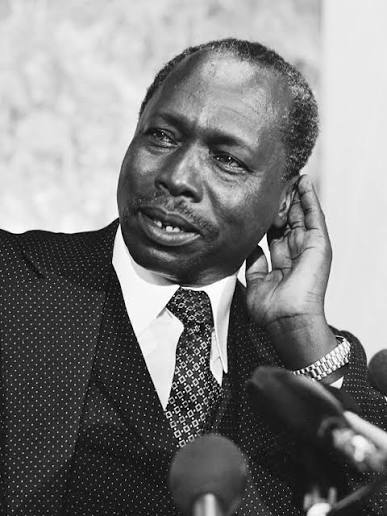
Moi was in Kabarak when the news reached him through Provincial Commissioner Isaiah Mathenge and Intelligence Director James Kanyotu. Securing a GSU escort, he traveled swiftly to Nairobi. By 3:00 PM that afternoon, Attorney General Charles Njonjo read the constitutional provision, and Daniel arap Moi was sworn in as acting President for ninety days.
In political circles, many dismissed the new President as a “passing cloud.” They viewed his modest educational background and his origins from the small Tugen community as weaknesses. Figures like Taaita Toweett, educated in Britain, and Jean-Marie Seroney, a lawyer trained in India, felt far more qualified to lead.
What they failed to realize was that Moi’s timid demeanor was a deliberate strategy. As he would later confide to Njiru, pretending to be weak and foolish was an effective political tactic. Beneath the unassuming exterior was a man built like steel.
The true shift in Moi’s presidency occurred on the morning of August 1, 1982, with the attempted military coup. Though the uprising was crushed by loyal infantry forces, the ordeal shattered any lingering trust within the political class.
As the gunfire cleared, General Jackson Mulinge, head of the Armed Forces, walked into State House carrying letters that had been intercepted in the post office. During the height of the chaotic uprising, two sitting Members of Parliament ,one from Kakamega and another from Kisii,had written separate letters to General Mulinge, urging him “not to forget them” when forming his new government. The coup was suppressed before the mail could be delivered, leaving the letters to land directly on the President’s desk. The MP from Kakamega collapsed and died shortly after the exposure; the MP from Kisii quietly retreated from the public eye.
From that moment on, Moi’s political posture altered completely. Surrounding him was a global wave of political violence: President Park Chung-hee of South Korea had been assassinated by his intelligence chief in 1979; William Tolbert of Liberia was killed in 1980; Anwar Sadat of Egypt fell in 1981; Olof Palme of Sweden and Indira Gandhi of India would soon follow, alongside Thomas Sankara in 1987. Survival required hyper-vigilance.
The political realignments came swiftly. In 1983, during a casual stopover in South Nyanza, President Moi remarked offhandedly that foreign powers were grooming a certain “traitor” to overthrow his government. He spoke casually, without emphasis, but Njiru recognized the weight of the statement.
Driving back to Nakuru with a small portable typewriter, Njiru drafted the press dispatch, placing the “traitor” comment directly in the lead paragraph. When the story hit the national headlines the following morning, a political earthquake shook the nation. Parliament picked up the story, and within days, Attorney General Charles Njonjo was explicitly named on the floor of the House, marking the beginning of his political downfall.
By the late 1980s, the political pressure shifted toward the queue-voting system (Mlolongo) and the push for multi-party democracy. International institutions and Western powers began using financial leverage to force political reform across Africa. While attending a course in London in 1990, Njiru was summoned to meet Stuart Innes, Head of the East Africa Department at the Foreign and Commonwealth Office.
Innes offered a blunt message for State House: “Go and tell President Moi that he has to embrace multi-party politics. It is a must. It is the mood of the times.”
As tension mounted internally, tragedies added to the political turmoil, most notably the disappearance and murder of Foreign Affairs Minister Dr. Robert Ouko in February 1990. Ouko and Moi shared a deep personal history dating back to 1961, when Moi, then Parliamentary Secretary for Education, met the young scholar at a UNESCO conference in Addis Ababa.
Both were former teachers, devout AIC church members, and close political allies. When rumors circulated linking top State House officials to Ouko’s death, Njiru maintained that if Moi wanted to neutralize a political figure, his established pattern was administrative demotion or dismissal,as he had done with powerful heads of civil service and police commissioners,rather than violence.
By late 1991, Section 2A of the constitution was repealed, restoring multi-party politics. The political landscape shifted dramatically. The opposition organized rapidly under the Forum for the Restoration of Democracy (FORD), while Mwai Kibaki launched the Democratic Party (DP).
Observing the massive opposition wave, Moi called Njiru into his office, visibly burdened. “Things are bad,” Moi told him. “The opposition has united, and most of the country is against us. Start packing up. We are going home.”
Njiru asked for time. “I don’t think we are going home,” he replied. “We just need to change the strategy.”
Reaching out to contacts within Military Intelligence and key political operatives, a quiet strategy was devised to fragment the formidable opposition block. Operatives allocated resources to print thousands of posters for Kenneth Matiba and financed artists to write popular campaign songs praising him. Matatu drivers were offered financial incentives to play Matiba’s campaign songs repeatedly on their routes, creating an illusion of overwhelming momentum.
Operatives then engaged Matiba’s inner circle, encouraging him to reject compromise and press for a direct mandate. They arranged for Martin Shikuku to convince Matiba that he held the dominant backing, encouraging a split within FORD.
To solidify Matiba’s confidence, political strategists organized a massive rally in the Rift Valley. Thousands of local supporters were bused to the roadside along the Nakuru highway, instructed to wave the two-finger multi-party salute as Matiba’s convoy passed. To Matiba, it appeared as though the Rift Valley had defected to his side; in reality, the crowds were systematically staged.
The strategy worked with precision. The opposition split into FORD-Asili under Matiba and FORD-Kenya under Jaramogi Oginga Odinga, while Kibaki ran separately under the Democratic Party. With the opposition vote splintered three ways across Mount Kenya, Western, and Nyanza, Moi secured victory in the 1992 general election, and repeated the strategic feat in 1997.
By 2002, as Moi reached his constitutional term limit, he selected Uhuru Kenyatta as his preferred candidate under KANU. When the opposition united under the NARC coalition and defeated KANU at the polls, observers declared it the end of the Moi era. Yet, as Njiru would often point out, from his entry into the Legislative Council in October 1955 to his retirement in December 2002, Daniel arap Moi’s own name had never once appeared on a ballot paper that he lost.